

Thesis: The real lesson of Galileo’s story is not “science versus religion,” but that both science and faith start from assumptions, work with limits, and call for humility about what we claim to know.
The title and basic ideas behind this post derive from Wade Rowland’s book Gailileo’s Mistake: The Archaeology of a Myth (Toronto: Thomas Allen Publishers, 2001).
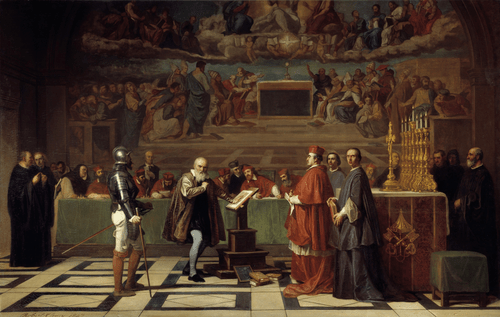
Wade Rowland makes a very persuasive case against the popular lesson drawn from the story of Galileo Galilee’s confrontation with the Roman Catholic church. Most of us were taught a simple version of the Galileo story: Galileo proved that the sun is at the center of the solar system, the Roman Catholic Church refused to listen, and eventually science defeated religion. It’s a powerful story, but it’s not quite what happened. In reality, many Catholic thinkers of Galileo’s time, including Pope Urban VIII, suspected that Galileo was probably right. They were not rejecting the idea of a sun-centered solar system out of blind dogma.
What they questioned was Galileo’s claim of certainty. To say something is a proven scientific fact, you need evidence that meets the standards of the time. In this case, the key test was whether you could detect a tiny shift in the positions of nearby stars as the Earth supposedly moved around the sun (stellar parallax). With the instruments available in Galileo’s day, that shift was far too small to measure. So while heliocentrism was a strong and useful theory, it was not yet “proved” by the best available tools. The clash was really about what counts as proof, not simply “Bible versus telescope.”
This pattern shows up again and again in the history of science. Newton’s laws of motion worked beautifully for centuries, until more precise measurements of Mercury’s orbit revealed small discrepancies. Einstein’s theory of relativity explained those discrepancies and gave us a deeper view of gravity and space-time. Yet we still use Newton’s equations every day, because they work well in most situations. In other words, when “the math works,” we haven’t necessarily found final truth—we’ve found a model that works within certain limits, until better measurements reveal where it breaks down.
Because modern science often deals with things too small, too large, or too distant to observe directly, it relies heavily on layers of instruments, computer models, and prior theories. Scientists must trust their tools, their training, and the community that checks and publishes results. That doesn’t make science untrustworthy; it makes it human. It also means science, like faith, involves starting assumptions and trust in authorities and methods. Science is not the opposite of faith; it is one more way human beings, with limited tools, try to understand reality.
Faith, in turn, is not just “believing without evidence.” In the Christian tradition, faith draws on personal experience, the shared wisdom of a community, and the authority of Scripture and history. Hebrews 11 describes faith as “confidence in what we hope for and assurance about what we do not see,” and then points to people like Noah, Abraham, and the prophets, who trusted God based on His past actions and promises, even when they could not see the final outcome. This is not blind guessing, but a reasoned trust in a God whose character and works have been witnessed over time.
Seen this way, Galileo’s story becomes a cautionary tale for both sides. Galileo reminds us that scientists can overstate what their evidence really proves; the Church of his day reminds us that religious institutions can mishandle disagreements and appear hostile to inquiry. The deeper lesson is that both science and faith require humility. We should be honest about the limits of our methods, clear about the role of assumptions and trust, and careful about claiming more certainty than our evidence truly supports.
 John Valade
Leave a comment