


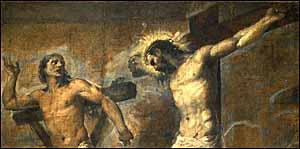
When Jesus tells the repentant thief on the cross,
“Truly I tell you, today you will be with me in paradise” (Luke 23:43),
most of us have heard one standard explanation:
- The thief dies that day.
- Jesus dies that day.
- Both go immediately to a pleasant part of Hades (the “good side” of the afterlife), a kind of heavenly waiting room called “paradise.”
But when we look more closely at the Bible, that explanation starts to feel too small and too inconsistent with the bigger story of Scripture. In this post, I want to walk through a simpler, more coherent way of understanding what Jesus meant—and how it fits into the larger picture of salvation, judgment, and our role as Christians.
1. Where Is Paradise?
Let’s start with the obvious question: What is “paradise,” and where is it?
In Revelation 2:7, Jesus says:
“To the one who is victorious, I will give the right to eat from the tree of life,
which is in the paradise of God.”
So:
- Paradise is where the Tree of Life is.
In Revelation 22:1–2, we see the Tree of Life again:
- It stands by the river of the water of life,
- Flowing from the throne of God and of the Lamb,
- In the New Jerusalem—the final, restored creation.
Now go back to Genesis 2:
- God plants a garden in Eden.
- In the middle of the garden are the Tree of Life and the Tree of the Knowledge of Good and Evil.
Put this together:
- The Tree of Life is in Eden, in God’s garden.
- Revelation places the Tree of Life in God’s final, restored creation.
- Jesus calls that place “the paradise of God.”
So biblically, “paradise” is best understood as God’s garden-presence—the Edenic, tree-of-life reality where God dwells with His people—not as a nice corner in the basement of Hades.
That’s our first big shift.
2. What Does “Today” Mean?
If “paradise” is the ultimate garden of God’s presence, does that mean the thief literally arrived there the same day he died?
To answer that, it helps to notice something Jesus is already doing on the cross.
In Mark 15:34, Jesus cries out:
“My God, my God, why have you forsaken me?”
This is a direct quote from Psalm 22. In other words, Jesus is praying the Psalms as He dies.
Now consider Psalm 95, which uses another important word:
“Today, if you hear His voice,
do not harden your hearts…” (Psalm 95:7–8)
In Psalm 95:
- “Today” is the day you:
- Hear God’s voice,
- Decide whether to harden your heart,
- Or respond in faith.
So when Jesus says to the thief,
“Truly I tell you, today you will be with Me in paradise,”
there are two layers:
- Calendar time: It is literally the “today” of their crucifixion.
- Spiritual “today”: It is the thief’s day of decision—his Psalm 95 moment:
- He admits his guilt.
- He recognizes Jesus’ innocence.
- He entrusts himself to Jesus: “Remember me when You come into Your kingdom.”
In plain language:
“Today” is the day you’ve stopped hardening your heart and turned to Me in faith.
Jesus is not just timestamping when the thief dies. He is announcing:
“Right now is the day of your salvation.”
3. But What About the Timing? Isn’t He in Paradise That Same Day?
The traditional reading says:
- Paradise is in Hades.
- Jesus goes there when He dies.
- The thief joins Him there “today.”
- Three days later, Jesus leaves; the thief stays behind.
That’s already awkward:
- The thief is supposedly “with” Jesus only for three days.
- Then Jesus leaves him in Hades and goes on.
When we look at the bigger Bible picture of resurrection and judgment, a much more consistent framework appears.
A Three-Stage Resurrection Pattern
In 1 Corinthians 15:21–23, Paul says:
- As in Adam all die,
- So in Christ all will be made alive,
- But each in his own order:
- Christ, the firstfruits.
- Those who belong to Christ at His coming.
- Then, the end, when He hands over the kingdom to the Father.
In other words:
- There isn’t just one “resurrection moment” and that’s it.
- There is an order, a sequence, and ultimately “all” are made alive in Christ.
Add Ezekiel 37 (the valley of dry bones), which, taken seriously, also pictures a mass resurrection and restoration of people who were long dead.
This creates room for:
- More than one resurrection event.
- God continuing His saving work beyond this present lifetime.
4. Predestination: Not Just “Who Gets In,” But “Who Is Called to Serve”
A lot of talk about predestination focuses on:
- “Who gets saved and who doesn’t.”
But Scripture gives another important angle.
In 1 Peter 2:9, Peter says:
“You are a chosen people, a royal priesthood, a holy nation, God’s special possession…”
Chosen for what?
- To declare God’s praises,
- To serve as priests and kings,
- To participate in God’s work of reconciliation.
In the Old Testament, when God “chooses” or “predestines,” it’s often:
- To a task:
- Samson—to deliver Israel.
- Moses—to lead Israel out of Egypt.
- Jonah—to preach to Nineveh (even if unwilling!).
In the New Testament, we’re still:
- Chosen not just to be saved,
but saved in order to serve.
So, when we talk about predestination:
- It isn’t just “Who ends up where?”
- It’s “Who is called now to help carry out God’s plan of reconciling the world to Himself?”
That includes how God will deal with the many, many people through history who lived and died in ignorance, confusion, or bad teaching.
5. Judgment as a Process, Not Just a Moment
Hebrews 9:27 says:
“It is appointed for man to die once, and after that comes judgment.”
We often hear this as:
- “You die, then in a split second you are eternally and finally assigned to heaven or hell.”
But in the Bible, judgment is often a process:
- The judges in Israel didn’t just announce verdicts; they ruled, led, corrected, and restored.
- Peter says judgment begins with the household of God (1 Peter 4:17)—that sounds like an ongoing work, not just a single instant.
Jesus also says:
“On this rock I will build my church, and the gates of Hades will not prevail against it” (Matthew 16:18).
Gates are defensive structures:
- If the gates don’t stand,
- Then what’s inside is no longer locked in.
Picture:
- Hades (the realm of the dead) as a walled city.
- Jesus and His church battering down the gates.
- Those inside are no longer trapped forever.
In this light:
- Death and judgment are real and serious.
- But God’s work with people is larger and longer than just a brief earthly life.
- Resurrection and judgment are part of God’s ongoing project to set things right, not just to close the door.
6. So What Did Jesus Actually Promise the Thief?
Putting all this together:
- Paradise is not a comfortable nook in Hades.
It is the garden-presence of God, linked to the Tree of Life in Eden and in the New Creation. - “Today” in Luke 23:43:
- Echoes the language of Psalm 95:
“Today, if you hear His voice, do not harden your hearts.” - Points to the thief’s moment of repentance and faith.
- It is his day of salvation, the day his heart softens and he turns to Christ.
- Echoes the language of Psalm 95:
- Jesus’ promise:
- Affirms the thief’s forgiven and secure future with Christ in God’s paradise.
- Does not require that he literally step into the final Eden that same calendar day.
- Fits into a larger story in which:
- Christ is the first raised.
- Others are raised at His coming.
- And ultimately “in Christ all will be made alive”, each in their order.
- The big picture:
- God is working out a long, multi-stage plan of reconciliation.
- Predestined people now are called to be priests and partners in that work.
- Judgment is not just one instant of sorting but an extended process of setting things right.
- The thief’s story becomes a model:
- When you truly turn to Christ—
today, whenever that “today” is for you—
your future with Him in God’s paradise is secure.
- When you truly turn to Christ—
In short, Luke 23:43 is not a proof-text for a small afterlife holding room. It is a window into a much larger, richer story:
- A garden called paradise,
- A Savior who quotes the Psalms as He dies,
- A criminal who finds his “today” of repentance at the last possible moment,
- And a God whose plan of salvation and judgment is bigger, more patient, and more coherent than most of our traditional shortcuts allow.
 John Valade
Leave a comment